 |
 |
|
||
 |
||||
Banflixcom Indian Free Official
 Note:
Note:|
Windows 7 users:
Use the EPSON Status Monitor for the driver included in Windows 7, Download the EPSON Status Monitor and its manual from the EPSON Web site. http://www.epson.com |
 Caution:
|
Although you can print to the printer directly connected to the computer in a remote location by using Remote Desktop function* of Windows 7, Vista, or XP, communication error may occur.
* Remote Desktop function: Function which enables a user to access applications or files in a computer connected to the office network from a mobile computer at a remote location. |
Note:|
If you are using a computer running Windows Vista x64 Edition with multiple users are logged on, a communication error message may be displayed when monitoring printers at the same time.
|
Setting up EPSON Status Monitor 3
 |
Open the Utility menu as described in Using the Printer Driver with Windows 7, Vista, XP, 2000, and Windows NT 4.0 or Using the Printer Driver With Windows Me, 98, and 95.
|
 |
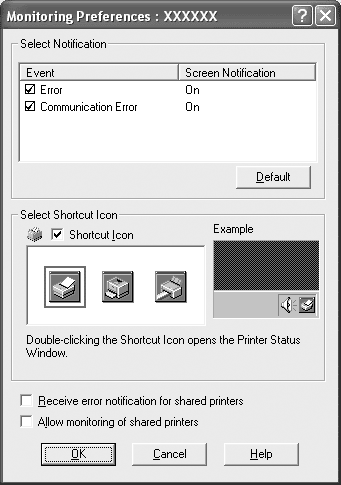
Click the Monitoring Preferences button. The Monitoring Preferences dialog box appears.
|
 |
The following settings are available:
|
Banflixcom Indian Free Official
Yet the language of “banflix” — and the networks that operate under similar monikers — also carries darker implications. Sites that promise “free” access frequently do more than bypass paywalls: they harvest data, inject malware, and sustain shadow economies that undercut creators, technicians, and the broader ecosystem that makes films possible. For independent filmmakers and regional artists in India, the economics are fragile; illegal distribution siphons away potential revenue, diminishes bargaining power for rights, and reduces incentives to invest in the kinds of risky, innovative projects that enrich a culture. The “free” that users love can translate into fewer original voices being heard tomorrow.
“BanflixCom Indian Free” is more than a search string; it’s a mirror held up to a world struggling to adapt to rapid technological change. The impulses it represents — desire for access, frustration with pricing, and willingness to bypass rules — are real and legitimate. The response should be equally real: redesign the services, strengthen safe access, protect creators, and educate users. Only by addressing supply, demand, and ethics together can we move past the unsatisfying binary of “ban” versus “free” and towards a media ecosystem that is both inclusive and sustainable.
At its core, the demand embodied by “Indian Free” is understandable. India is a nation of vast socio-economic diversity; streaming subscriptions that cost a few dollars a month in wealthier markets can be prohibitive for large swaths of the population. Add layers of regional language preferences, patchy broadband, and device constraints, and a powerful incentive emerges to find free — or cheaper — routes to the films and shows people want. Platforms that lock content behind geoblocks or steep prices risk alienating audiences who feel treated as afterthoughts in a global marketplace. That mismatch fuels not just piracy but a broader critique: why should culture be commodified in ways that exclude so many? banflixcom indian free
Enforcement, too, is a blunt instrument. Aggressive takedowns and blunt legal threats against individual users are unlikely to succeed at scale and risk alienating the very audiences rights holders want to serve. Instead, nuanced enforcement that targets large-scale operators combined with constructive outreach — promotional partnerships, affordable bundles, and educational initiatives — will produce better cultural outcomes. In the Indian context, where informal sharing networks and community norms have historically shaped media consumption, solutions must be culturally informed and pragmatic.
The internet is a crowded, cacophonous space where entertainment and ethics often collide. “BanflixCom Indian Free” reads like a slogan, a search term, and a symptom all at once — a raw distillation of online demand for free access to media, a cry against perceived gatekeepers, and a hint of the legal and cultural frictions that follow. To consider this phrase seriously is to sit with the many contradictions of our digital age: the hunger for stories, the erosion of traditional revenue models, and the uneasy moral calculus users make when convenience, cost, and copyright intersect. Yet the language of “banflix” — and the
Finally, this phrase invites a broader philosophical question: what is the moral economy of culture in an age of abundance? The marginal cost of digital distribution is near zero, yet the social practices around ownership and compensation lag behind. We must invent new frameworks — micropayments, ad-supported tiers with transparent revenue sharing, cooperative licensing models — that reconcile universal access with fair returns for creators. That kind of systemic creativity is the antidote to the quick fixes that “free” piracy promises.
Legality aside, there is a cultural and ethical conversation to be had. One can be sympathetic to consumers’ needs while insisting on better systems. The fight shouldn’t be binary — pro-piracy versus pro-corporate lockout — but rather focused on redesigning access. That means more affordable, localized pricing tiers; strengthened availability of regional-language catalogs; lighter-weight streaming options for low-bandwidth contexts; and robust public-policy measures that encourage affordable cultural access without wrecking creators’ livelihoods. Many Indian platforms and global services have made progress on this front, but inconsistency persists: some regions get generous libraries and price sensitivity, others remain paywalled or ignored. The “free” that users love can translate into
We also need to reckon with the role of intermediaries and search culture. The rise of search queries like “banflixcom indian free” shows how users are trained to treat the internet as a tool for circumventing scarcity. Tech companies and search engines have a responsibility here: presenting safe, legal options prominently and deprioritizing malicious or infringing sites reduces harm. Equally, digital literacy campaigns can remind users that “free” often has hidden costs — to devices, to privacy, and to the people who produce the work they consume.
Note:|
Click the Default button to revert all items to the default settings.
|

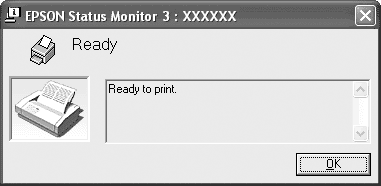
Accessing EPSON Status Monitor 3
 Note:
Note:|
It might not be possible to retrieve the printer status during printing. In this situation, click the EPSON Status Monitor 3 button in the Utility tab, and use the printer with the status window left open.
|
Installing EPSON Status Monitor 3
|
Make sure that the printer is off and that Windows is running on your computer.
|
|
Insert the printer software CD-ROM in the CD-ROM drive.
|
Note:|
If the language selection window appears, select your language.
If the EPSON Installation Program screen does not appear automatically, double-click the My Computer icon, right-click the CD-ROM icon, click Open in the menu that appears, then double-click Epsetup.exe.
|
|
Click Continue. When the software license agreement screen appears, read the statement, then click Agree.
|
 |
Click Custom Install.
|
 |
Click the EPSON Status Monitor 3 button.
|
 |
In the dialog box that appears, make sure that your printer icon is selected, and click OK. Then follow the on-screen instructions.
|
 |
When the installation is complete, click OK.
|